Costa Rica Airborne research on foresT Ecosystem Response to volcanic emissions (CRATER)
NASA Ames Research Center's Flight Operations and Earth Science Divisions, in collaboration with Black Swift Technologies LLC, deployed the fixed-wing S2 UAS in Costa Rica. The mission collected airborne infrared imagery and measured gas concentrations (CO₂, H₂O, H₂S, SO₂) along with SO₂ plume cross-sections on the south-southeastern flank of Rincón de la Vieja volcano. This effort enhances concept-of-operations and deployment logistics, enabling NASA to conduct routine and ad-hoc airborne investigations into the impacts of persistent volcanic emissions on tropical ecosystems.
Rincón de la Vieja volcano serves as a key site for studying vegetation responses to prolonged exposure to elevated CO₂. These environments function as natural laboratories, offering insights into how rising atmospheric CO₂ levels affect tropical forest growth and stability. Additionally, ecosystem responses to increased CO₂ may serve as early indicators of volcanic activity before and between eruptions.

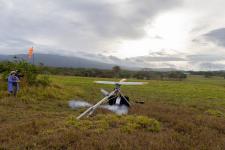
NASA ARC Black SwiftTM S2 UAS take off.

Representative flight path of the NASA ARC Black Swift S2 along the southern flank of Rincón de la Vieja volcano, Costa Rica.